Lab Facilities
The Trimmer Laboratory occupies a new, purpose-designed research facility within the Tufts Integrative Neuromechanics Group. Our laboratory brings together the tools needed to study biological systems from cellular physiology and neural activity through whole-animal behavior and biomechanics, and to translate these principles into soft and biohybrid robots. In addition to approximately 1,010 ft² of dedicated laboratory space, we share equipment and expertise with neighboring laboratories studying neurobiology and biomechanics.

Neurophysiology and Muscle Mechanics
Our electrophysiology suite contains six independent experimental stations for intracellular and extracellular recording, live microscopy, EMG, and muscle physiology. Each station is equipped with vibration isolation, microscopy, micromanipulation and computerized data acquisition.

Microscopy and Functional Imaging
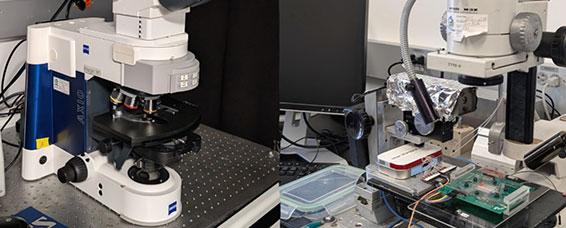
The laboratory has compound and fixed-stage microscopy systems for cellular neurophysiology, anatomy and fluorescence imaging. These include Zeiss Axioscope and Axio-Imager M1 microscopes, an AxioCam 503, a PCO-Edge 104 sCMOS camera and filter sets for commonly used fluorophores.
Behavior, Motion Analysis and High-Speed Imaging
We use high-speed and high-resolution imaging to quantify movements ranging from rapid defensive responses to locomotion and the motion of individual appendages and tissues.
Animal movements can be quantified using SLEAP and other tracking approaches. A custom-built insect treadmill allows controlled analysis of locomotion, while three infrared diode lasers provide spatially and temporally controlled thermal stimuli for our studies of nociception. Remote HD cameras allow behavioral experiments to be monitored over much longer periods.

Tissue Engineering and Cell Culture
A dedicated tissue culture laboratory supports our work on insect and vertebrate cells and the development of biohybrid devices. The facility includes a new biosafety cabinet, controlled incubators and equipment for sterile cell culture and tissue engineering. We use these facilities to develop insect muscle cultures and engineered contractile tissues and for embryo injections.

Manduca sexta Colony
Our long-established colony of the tobacco hornworm, Manduca sexta, is in a dedicated 243 ft² husbandry room containing large environmental chambers with controlled temperature, lighting, and humidity. Adult moths are housed in a large breeding cage with dedicated dust extraction. Separate incubator space is available for maintaining experimental, transfected, or genetic lines.

Soft Robotics and Rapid Prototyping
The laboratory has extensive in-house capabilities for designing and fabricating experimental equipment, soft robots and biohybrid devices. Our rapid-prototyping facility includes a Bambu Lab X1E FDM printer, Roland MDX-40 four-axis milling system, Shining 3D EinScan SP V2 three-dimensional scanner and MCP 5/01 vacuum casting system. Together, these tools allow us to move rapidly from CAD designs to molds, mechanical components and cast soft structures.
Additional fabrication capabilities are available through the nearby Tufts Nolop Fabrication Facility, including machining, additive manufacturing and electronics assembly.
