Collective Behavior Under Stress
Social insect colonies provide powerful systems for studying how local interactions generate large-scale outcomes. In the Starks Lab, we investigate how honey bee colonies respond to environmental stressors, with a particular focus on thermoregulation, nutritional ecology, disease response, and collective decision-making.
Much of our current work uses observation hives and field experiments to explore how colonies maintain stability under changing conditions. These studies examine how workers regulate brood temperature, allocate labor, adjust foraging behavior, and coordinate colony-level responses when environmental conditions deteriorate.
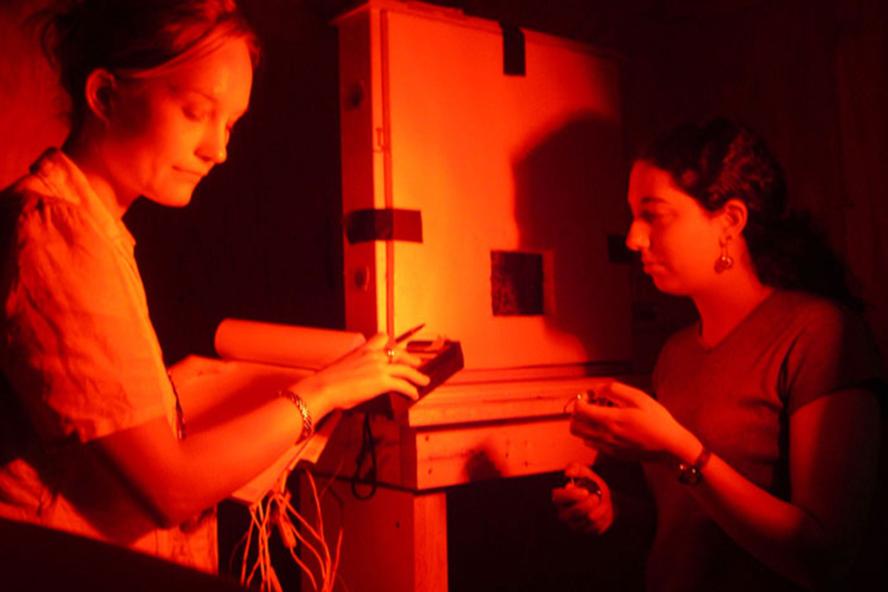
One long-standing area of research in the lab examines thermoregulatory defense behaviors in honey bees. Honey bee colonies can elevate brood temperature in response to infection by the heat-sensitive fungal pathogen Ascosphaera apis, producing a colony-level “behavioral fever” that inhibits pathogen development. We also study heat-shielding behavior, in which workers cluster along internally heated hive surfaces to reduce heat transfer into the colony and stabilize brood-comb temperature. More recent work suggests that colonies also respond to chronic-localized heat stress by altering the arrangement of brood and food stores within the hive itself.
Our research also examines how colonies respond to nutritional and environmental variability. Recent projects have explored how honey bees adjust micronutrient foraging preferences across seasons, how colonies respond to nutritional limitation, and how environmental conditions shape foraging and collective regulation.
Together, these projects address broader questions about collective resilience: how distributed systems detect stress, process information, and coordinate adaptive responses without centralized control. Current work also explores how genetic diversity influences the robustness and flexibility of colony-level responses under stress.