Facilities
The Starks Lab is based in the renovated Bacon Hall research complex at Tufts University. Research facilities include honey bee observation systems, outdoor research enclosures, dedicated insect colony rooms, and shared analytical facilities.
The laboratory emphasizes whole-organism and colony-level approaches to behavioral ecology, combining controlled observation with ecologically relevant field conditions. Current facilities support research on honey bees, paper wasps, and developing ant colony systems, while providing undergraduate and graduate students with direct access to live social insect research.
Honey Bee Research Enclosures
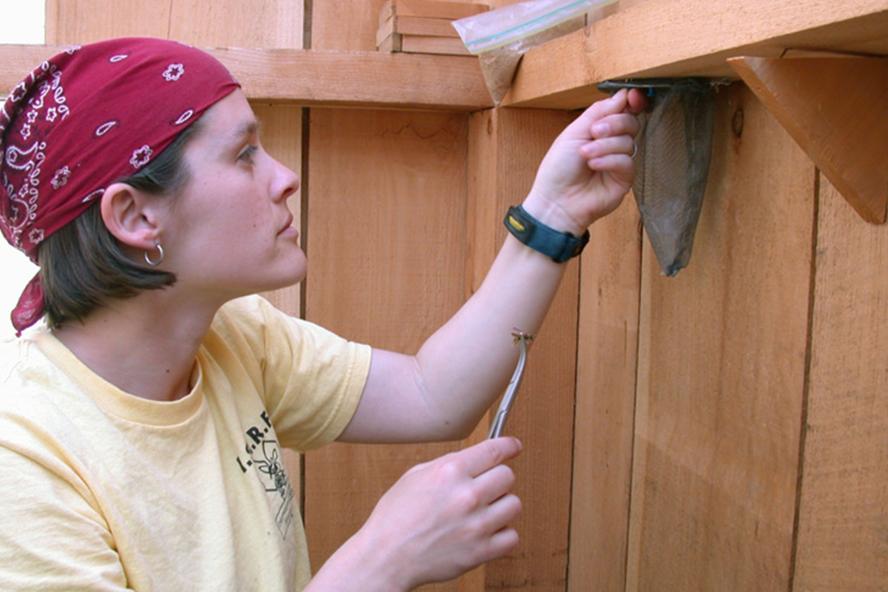
The laboratory maintains fenced semi-field honey bee research areas adjacent to the Tufts Medford campus. These outdoor facilities contain custom observation-hive huts that allow colonies to forage naturally while remaining continuously accessible for long-term behavioral and environmental studies.
Current research infrastructure supports experiments on colony thermoregulation, collective behavior, nutritional ecology, environmental stress, and comb organization. Colonies housed in vertical two-frame observation hives can be monitored repeatedly over extended periods while remaining connected to the surrounding landscape through external flight access.


The research enclosures have supported published work on chronic-localized heat stress, colony thermoregulation, and honey bee behavioral responses to environmental change. The laboratory is currently renovating and expanding portions of the outdoor enclosure infrastructure to support additional long-term colony experiments.
Observation Hive Systems
Honey bee colonies are housed in vertical two-frame observation hives designed for repeated behavioral and colony-level monitoring. Transparent hive walls allow direct observation of brood organization, food storage, worker behavior, thermoregulatory responses, and collective colony dynamics.


These systems support experiments that bridge controlled laboratory observation and natural foraging behavior. Observation hives have been used in studies of heat shielding, comb rearrangement, nutritional ecology, micronutrient foraging, and environmental stress responses. Because colonies remain connected to the external environment, the system allows researchers to investigate how honey bee colonies respond to changing ecological conditions while maintaining experimental accessibility.
Social Insect Colony Rooms
Dedicated insect rooms within the renovated Bacon Hall research suite are currently being configured for long-term maintenance and behavioral study of social insect colonies. These controlled indoor spaces support the laboratory’s expanding work on ant colony organization, collective behavior, environmental response, and social evolution.
The indoor colony facilities complement the laboratory’s outdoor systems by allowing year-round maintenance, controlled environmental conditions, and detailed behavioral observation. The laboratory also maintains open research bench space within Bacon Hall for behavioral ecology, colony maintenance, imaging, experimental setup, and undergraduate research activities.

Outdoor Wasp Enclosures
The laboratory is currently revitalizing semi-natural outdoor enclosures for Polistes paper wasps. These facilities are designed to support future research on social behavior, colony organization, reproductive conflict, environmental stress, and the evolution of sociality.
The outdoor enclosure system allows colonies to be studied under ecologically relevant conditions while remaining experimentally accessible for long-term behavioral observation.
Shared Analytical & Research Facilities
In addition to dedicated social insect infrastructure, the laboratory has access to shared molecular, analytical, imaging, and preparation facilities within the renovated Bacon Hall research complex. These facilities support integrative research approaches that connect behavior, ecology, physiology, and environmental response across levels of biological organization.
- Molecular Biology: Workspaces for DNA extraction, PCR, and molecular analyses
- Environmental Growth Rooms: Controlled-environment chambers for temperature and light manipulation
- Microscopy: Shared microscopy resources and imaging support infrastructure
- Shared Equipment: Preparation rooms and analytical support shared across the research complex
Undergraduate & Graduate Research
A central goal of the laboratory is the integration of research and teaching. Undergraduate and graduate students participate directly in colony maintenance, behavioral observation, field experiments, data collection, and independent research projects.


Laboratory infrastructure is closely connected to teaching within Animal Behavior, Field Methods in Ecology, and related organismal biology courses at Tufts University. Students gain hands-on experience working with live social insect systems while contributing to ongoing research in behavioral ecology and evolutionary biology.