Postdoctoral Scholars

Li-Wei Chao
Postdoctoral Scholar
Advisor: Jonah Bloch-Johnson
My research focuses on clouds in climate science, using a combination of satellite observations, Earth system models, and km-scale global storm resolving models. I am particularly interested in understanding how clouds respond to climate change, one of the most critical yet uncertain components of our warming world. My research tackles this complex question by investigating how clouds interact with warming patterns using satellite observations and climate models and evaluating the representation of cloud processes in global climate models and storm-resolving models.
At Tufts, I am working with Jonah Bloch-Johnson to investigate the dependence of cloud feedback on sea surface temperature pattern changes and on background mean states, which is essential to further advancing our understanding of the mechanisms driving cloud feedbacks and improving future climate projections.
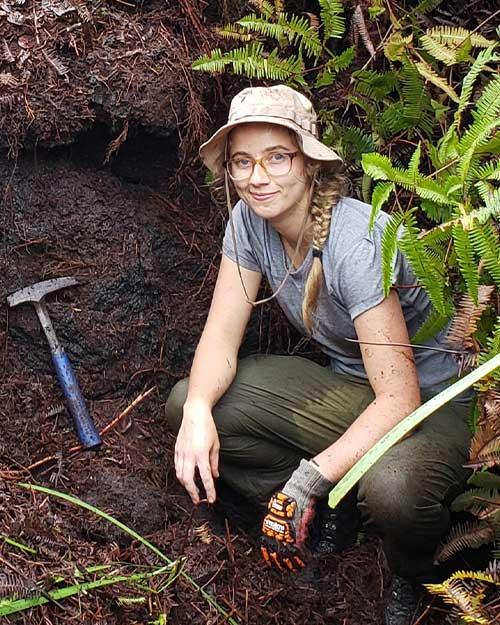
Rose Gallo
Postdoctoral Scholar
Advisor: Jill VanTongeren
Area of Study: I am interested in the processes that occur in magma chambers: how magmas interact and what happens during magma storage. I use the textural characteristics and major and trace chemistry of igneous rocks and minerals to investigate these subjects. My PhD focused on magma bodies within one of the rift zones of Kīlauea volcano. I investigated the chemical changes that magmas undergo between eruptions, syn-eruptive mingling processes, and a unique magma encountered in a geothermal borehole which I used to test the utility of common petrologic tools for inferring magma storage conditions.
At Tufts, I will be characterizing the chemical and textural features of the Dufek Intrusion, a Jurassic layered mafic intrusion in Antarctica. I hope to use new compositional information to model possible scenarios for the cooling history of the Dufek magma body.

Ryan Stoner
Postdoctoral Scholar
Advisor: Dylan Vasey
Area of Study: I research how tectonic processes can be constrained by their self-consistent evolution in numerical geodynamic models. These models act as a sandbox for identifying and disentangling feedback loops — for example, the coupling between hydration of the mantle wedge and the stress state of subduction-zone forearcs. Refining these feedbacks motivates my work on method development: incorporating constraints from novel geological and geophysical observables into a common framework for the wider community.
At Tufts, I am working with Dylan Vasey on rift inversion. This work breaks new ground in how lower-crustal processes, such as sediment melting, interact with surface processes to shape rift-inversion orogens. We are also developing open-source methods to model and predict the evolving detrital thermochronological signal during collision.
Paul Summers
Postdoctoral Scholar
Advisor: Becca Jackson
Area of Study: I am interested in understanding the processes that control the fastest flowing ice of Earth’s ice sheets, from ice divide until where the glacier calves and melts into the ocean. I use numerical models to focus on physical processes that enhance glacier flow, calving, and melting. I test these models against observations using remote sensing, in situ, and paleo observations (records of past ice flow/extent). For my PhD I used idealized models to understand the processes that control the width of ice streams in Antarctica.
At Tufts I am working with Rebecca Jackson and Alex Robel at the Georgia Institute of Technology to build a coupled Glacier-Mélange-Ocean model. This project will help us understand the complex, coupled fjord system that controls ice mass loss at the marine boundary of the Greenland Ice Sheet. Glacier calving and submarine melt represents roughly half of Greenland's total contribution to global sea level, yet these processes remain poorly understood. Through this work, we hope to better understand what feedback processes control ice mass loss and fresh water export from the Greenlands Ice Sheet, and future sensitivity to changes in climate forcing.
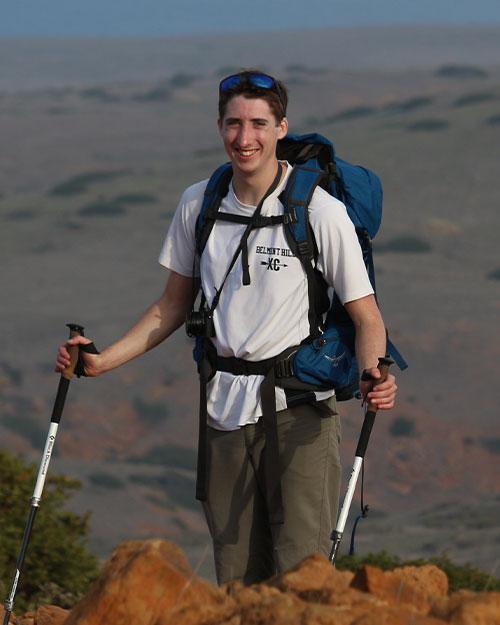
Duncan Wheeler
Postdoctoral Scholar
Advisor: Becca Jackson
Area of Study: I am a coastal physical oceanographer with broad research interests in identifying problems where a better physical understanding of the ocean can help with climate change impact predictions, climate change adaptation, ecosystem management, and community-based decision making. My expertise is in working at the intersection of theory and observational oceanography, including methodological development and comparing observations to analytical models for a better understanding of small‐scale processes. I have experience working in a range of coastal systems, with a focus on understanding boundary layer dynamics.
At Tufts, I am working with Rebecca Jackson to study the ice‐ocean boundary at marine terminating glaciers. I am currently using remotely operated vehicles to study the dynamics of a plume of buoyant water rising along the face of Xeitl Sít, a glacier in Alaska. Ocean-glacier interactions form a large part of our uncertainty on how fast glaciers in the northern hemisphere retreat. By improving our understanding of the relevant dynamics, we can enable climate modelers to better predict future changes.