Q&A: From Stargazing to Subatomic Particles
By: Maisie O'Brien
The night sky above Inyo National Forest in California is blanketed with stars, with the full Milky Way shining overhead. Crystalline glaciers and 4,000-year-old trees dot the earth below. It is Will Tripp’s favorite place to camp, gaze up at our galaxy, and contemplate humanity’s place within it.
At Tufts, Tripp earned an MS in physics and will begin a PhD this fall. He fell in love with the subject because of his natural aptitude for numbers and physics’ unique ability to explore the universe and tackle profound existential questions.
He earned a BS in physics and mathematics with a minor in astronomy from Dickinson College, where he worked as a teaching assistant and participated in research. A lifelong runner, he also worked at a specialty running store. Tripp chose to attend Tufts because of the Physics Department’s accomplished faculty, Boston’s reputation as an academic hub, and the area’s vibrant running culture.
What kind of research experience have you gained at Tufts?
My research as a graduate student focuses on neutrinos, tiny, low-mass subatomic particles that are among the most abundant forms of matter in the universe. Hundreds of billions pass through your body every second, yet there is still so much we don't know about them, including why they have mass. I work on experiments that measure how neutrinos change "flavor," the term physicists use to describe different types of neutrinos, as they travel long distances. As a master's student, I conducted research as part of the NOvA (NuMI Off-Axis ve Appearance) experiment, an international collaboration that uses detectors in Illinois and Minnesota to measure neutrino oscillations, and better understand their role in the universe.
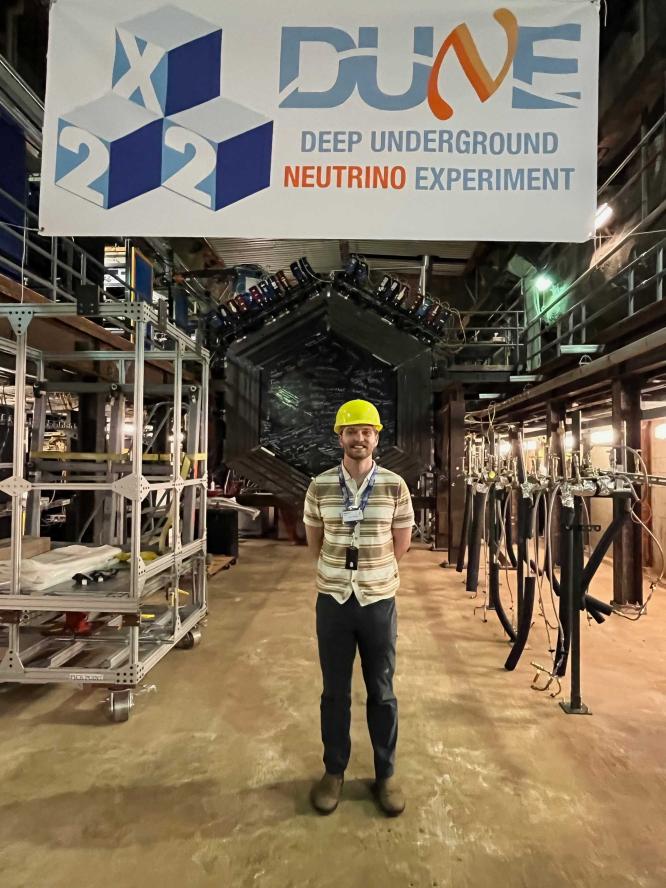
Now, as a PhD student, I am joining the Deep Underground Neutrino Experiment (DUNE). DUNE is the much larger successor to NOvA and will send an immense number of neutrinos 800 miles through the Earth to massive 14,000-ton detectors filled with liquid argon in South Dakota. The experiment aims to determine the relative scale of neutrino masses and help explain why the universe is composed primarily of matter. My thesis research will focus on neutrino interactions. Because neutrinos interact so rarely and do so inside complex argon nuclei, it is extremely difficult to disentangle the physics of nuclear interactions from the neutrino interactions themselves. Solving that puzzle is the central focus of my work.
Ultimately, I am driven by a desire to contribute to our understanding of the universe and our place within it. Both NOvA and DUNE are large international collaborations, with DUNE bringing together researchers from more than 35 countries. They’re a powerful example of how science can unite people and build communities that transcend national borders. On a personal level, I find tremendous satisfaction in the research process itself: learning how to ask the right questions when faced with uncertainty and finding meaningful ways to share what I've learned with others.
Describe the community of faculty and students in the program.
There are so many great things about being a physics student at Tufts, but one of the best is the strong sense of encouragement and community. The department's Neutrino Group has gone above and beyond in supporting me. I've had the chance to work with incredible mentors, including Tony Mann, who challenges students to tackle complex physics concepts, and my principal investigator, Jeremy Wolcott, who has been an exceptionally supportive advisor. As a master's student, I received funding from the department to attend conferences on neutrino interactions in Germany and Southern California, where I presented posters on my research. The support of my research group played a major role in my decision to stay at Tufts for my PhD.
The department fosters a close-knit culture from day one. First-year graduate students share a glass-walled office space known as "the fishbowl," which is designed to encourage collaboration. Some of my favorite memories involve working through challenging problem sets alongside classmates and playing on the Physics and Astronomy softball team each summer. The team brings together nearly 30 people to play, socialize, and build lasting friendships.
Additionally, having the support of our department's Physics Education Research Group has been an incredible resource for my role as a teaching assistant. Teaching has been one of the most rewarding things I get to do at Tufts because of its direct impact on students' lives. It is incredibly satisfying to see students dig in and start finding answers to their own questions. Beyond helping them, teaching step-by-step has been immensely helpful to my own learning process, as there is no better way to discover your knowledge gaps than trying to explain a concept to someone else. There’s a contagious excitement that comes from teaching physics—I love it!
What’s next for you?
Next for me is to continue pursuing physics and work toward getting my PhD, with the goal of staying in research as a postdoc or staff scientist. While those positions are really competitive and hard to come by, I am definitely going to work hard to pursue those experiences. My time at Tufts has really reaffirmed my path and strengthened my outlook, reinforcing the idea that working on large international collaborations and being a part of big, exploratory research is incredibly fulfilling.
Throughout my life, I want my work to contribute to something larger than myself. Whether through research, teaching, or mentorship, I hope to have a positive impact on the world both within and beyond the scientific community.
I am also looking forward to the academic side of my future and doing more teaching. I’ve thought about becoming a professor or teaching at the high school or community college level. Beyond that, I am keeping my options open, as there are also lots of industry jobs, but my immediate plan is to dive into my doctoral research and see where it leads.